
The most expensive assumption facility managers and event organizers make about a digital name badge is treating it as a digital version of a plastic rectangle. A plastic badge is a visual assertion; a digital badge is a dynamic credentialing protocol. When organizations swap physical lanyards for mobile wallet passes without understanding the underlying mechanics - how NFC endpoints poll, how dynamic QR codes handle offline states, or how data minimization impacts network security - the deployment fractures under the weight of edge cases. This shift requires understanding not just how identification displays on a screen, but how it interacts with the access and networking infrastructure around it.
Quick Summary
A digital name badge is an interactive credential stored on a mobile device, utilizing Near Field Communication (NFC), dynamic QR routing, or mobile wallet integration to authenticate identity. It replaces static printed access cards with cryptographic, trackable, and remotely updatable endpoints.
- Reduces credentialing latency by pushing real-time permission updates directly to an employee's mobile wallet.
- Relies on standard data formats (NDEF, .pkpass) to ensure cross-platform interoperability without requiring native app installations.
- Demands explicit data minimization architectures to prevent unauthorized payload harvesting during active transmission.
- Requires specific hardware alignment, caching contingencies, and lighting strategies to prevent scanning failures at the access point.
Table of Contents
- The Mechanical Shift From Visual to Interactive Credentials
- Protocol Mechanics Behind the Screen
- Where Deployment Fractures in the Field
- Data Minimization in Credential Infrastructure
- Format Trade-offs: Static, Dynamic, and Hybrid Stacks
- Metrics for Migration and Access Evaluation
- FAQ
- Recommended Reads
The Mechanical Shift From Visual to Interactive Credentials
For decades, identity verification relied entirely on visual validation. A security guard or a desk clerk looked at a piece of cardstock, checked a printed photograph, and made a localized access decision. This model breaks down at scale because visual credentials cannot be remotely revoked, cannot log their own usage, and rely entirely on human attention spans.
Choosing the correct business cards format for your organization is no longer a graphic design question; it is an infrastructure decision. A modern digital credential moves the validation burden from the human eye to a cryptographic exchange. When an individual presents a mobile wallet pass, the system does not merely display a name. It initiates a handshake between the mobile operating system and the scanning terminal. The terminal reads a tokenized payload, pings a centralized directory via an API, confirms the credential's active status, and logs the interaction.
This fundamental shift eliminates the latency of physical reprinting. When an employee's role changes, or an attendee upgrades their conference ticket, the underlying system pushes an over-the-air update to the device. The screen reflects the new status instantly. However, mapping this transition requires understanding the underlying hardware limitations. As you will find when evaluating the transition to digital ID cards and advanced networking tools, replacing a physical token with a digital one introduces a dependency on the user's mobile device battery, the operating system's background processes, and the ambient environment of the scanning location.
Protocol Mechanics Behind the Screen
Understanding a digital credential requires unpacking the specific file formats and transmission protocols that make it work. The industry standard for mobile deployment is the wallet pass, predominantly utilizing the .pkpass file structure.
A .pkpass file is fundamentally an encrypted ZIP archive containing a JSON dictionary (which defines the text, colors, and layout), visual assets (PNG files for logos and barcodes), and a cryptographic signature. This signature is the critical component: it proves to the Apple Wallet or Google Wallet application that the credential was generated by an authorized issuer and has not been tampered with since creation.
When it comes to transmission, these credentials rely on two primary mechanisms: Optical (QR) and Radio Frequency (NFC).
Optical transmission utilizes dynamically generated QR codes. Unlike a static QR code that hardcodes a URL into a matrix of black and white squares, a dynamic credential generates a time-sensitive, rotating token. If a malicious actor screenshots the QR code, the captured image will expire and fail to authenticate within seconds.
Radio Frequency transmission relies on the NFC Data Exchange Format (NDEF). Reviewing an NFC and digital business card innovations technical overview reveals that when an NFC-enabled smartphone comes within a few centimeters of a reader, magnetic induction powers a tiny antenna in the scanning hardware. The device transmits a lightweight NDEF payload containing the user's unique identifier.
Practical rule: Always provision a fallback optical format (like a QR code) alongside an RF-based credential (like NFC), because mobile operating systems routinely suppress background RF transmission when device batteries fall below critical thresholds.
Where Deployment Fractures in the Field
The most common symptom of a failed deployment is a line of frustrated users staring at a terminal that refuses to scan. From the outside, these failures look identical. Under the surface, they stem from three distinct mechanical breakdowns.
Focal Plane Collapse
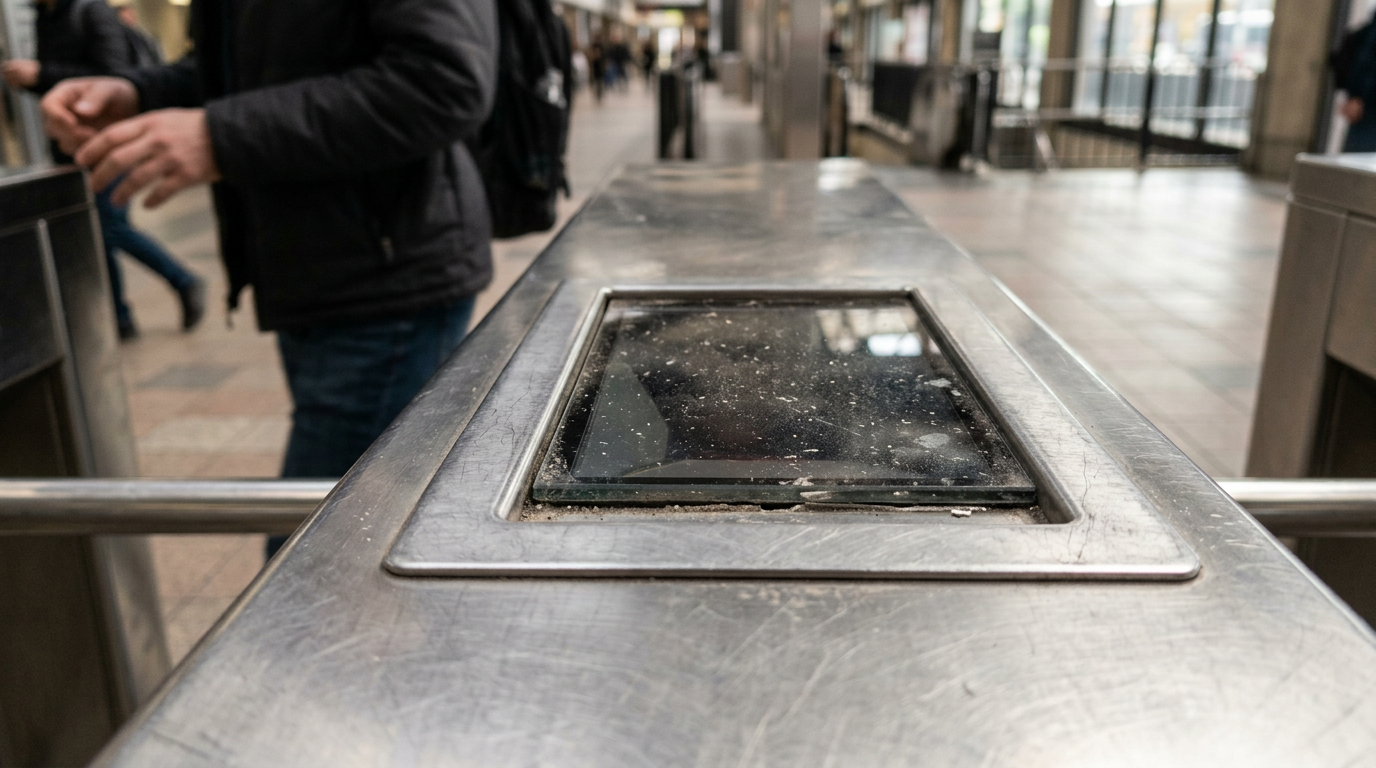
When utilizing QR-based transmission, the hardware scanner relies on a built-in camera to acquire the image. Users instinctively push their smartphone screen directly against the glass of the scanner. This pushes the QR code inside the camera's minimum focal distance, causing the image to blur beyond the software's ability to decode the matrix.
Diagnosis: Does the scanning hardware emit an error tone, or does it stay completely silent? A silent scanner means it cannot see a barcode at all. The fix requires physical spacers on the scanning terminal to enforce a two-inch gap between the screen and the lens.
Wallet Cache Desynchronization
Mobile wallets are designed to cache data so credentials load instantly, even in dead zones. However, if an administrator revokes a badge or updates a permission level while the user's device lacks cellular service, the wallet will continue displaying the cached, outdated credential.
Diagnosis: Did the user open the credential via a wallet app or a browser cache? Consulting a technical deployment guide for QR code business cards will often show that forcing a manual pull-to-refresh on the wallet pass forces the OS to poll the server for the current token.
OS-Level Hardware Suppression
Modern smartphones aggressively manage power and notifications. If a device is placed in 'Do Not Disturb', 'Low Power Mode', or if the user has disabled background NFC polling, the wallet pass will fail to transmit its payload to the reader, even if the screen is unlocked.
Diagnosis: Ask the user if their device is running on a low battery or if focus modes are active. The immediate fix is swapping to the optical QR fallback, bypassing the NFC hardware entirely.
Data Minimization in Credential Infrastructure
The moment you digitize an identity, you create a trail of telemetry. Every scan, every access request, and every digital handshake generates a data point containing timestamps, geographic locations, and device identifiers. How an organization handles this telemetry separates a secure deployment from a privacy liability.
Robust credential infrastructure operates on strict data minimization principles. The core mechanism is processing without permanent storage. When a digital badge is scanned, the API endpoint receives the token, compares it against the active directory, returns a binary 'yes' or 'no' authorization, and immediately discards the request payload. The system retains an anonymized log of the access event, but it does not store the specific device footprint or browser string of the user.
Furthermore, secure architectures strictly partition credential data from analytical processing. Understanding how to create business cards for digital wallets and QR ecosystems necessitates strict data policies that guarantee user inputs and access logs are never ingested to train machine learning models. A credentialing system that monetizes or trains on access telemetry introduces unacceptable corporate espionage risks.
Practical rule: If an identification system requires a user to download a proprietary, third-party application to present their credential, it has failed the interoperability test and will suffer from adoption drop-off. Always utilize native OS wallet frameworks.
Format Trade-offs: Static, Dynamic, and Hybrid Stacks
Selecting the right access stack requires matching the credential format to the physical environment. Deploying a purely digital solution in an environment that cannot support the necessary networking infrastructure guarantees failure. Exploring hybrid models for digital and physical business cards provides a fallback for edge cases.
| Credential Format | Transmission Method | Update Latency | Primary Failure Mode |
|---|---|---|---|
| Static Plastic RFID | Low-frequency radio wave | Days (Requires physical replacement) | Lost or cloned physical cards |
| Native Wallet Pass (.pkpass) | NFC or Dynamic QR | Seconds (Over-the-air API push) | Dead smartphone batteries |
| Browser-based Web App | Screen-rendered QR | Seconds (Requires page refresh) | Lack of cellular data at the door |
| Hybrid (Smart Card + QR) | NFC chip + printed optical | Instant (NFC) / Static (QR) | High unit cost per user |
Organizations operating air-gapped facilities, secure compartmentalized information facilities (SCIFs), or heavy industrial sites where personal electronics are banned on the floor should skip native wallet passes entirely. Bring Your Own Device (BYOD) credentialing expands the attack surface unacceptably in these environments. For corporate offices, trade shows, and standard access control, native mobile wallets offer the most secure, easily revokable solution available.
Metrics for Migration and Access Evaluation
When migrating from a legacy physical system to a digital credentialing stack, do not measure success by how modern the system looks. Measure it by specific operational metrics that define access efficiency.
First, measure your time-to-provision. In a legacy system, onboarding a new employee involves printing a card, encoding a chip, and physically handing it to them - a process that often takes 24 to 48 hours. A successful digital deployment should reduce this to under five minutes, generating a secure enrollment link and pushing the .pkpass file directly to the user's device before they arrive at the building.
Second, track the first-scan failure rate. In the first two weeks of deployment, monitor how many users require a manual override at the terminal. If the failure rate exceeds 3%, you do not have a user training issue; you have an environmental issue. The ambient lighting is washing out the QR scanners, the NFC readers are calibrated poorly, or the readers lack cellular backhaul to verify dynamic tokens.
Finally, test credential revocation latency. The defining advantage of a dynamic badge is security. When an administrator revokes a user's access in the central dashboard, use a stopwatch to measure how long it takes for the wallet pass on the device to transition to an inactive state. If the pass still scans successfully after 60 seconds, your API polling frequency is set too low, leaving a dangerous window for unauthorized access.
FAQ
How do offline environments affect dynamic QR credentials?
If a user's device cannot reach the network, the wallet pass relies on a pre-fetched batch of cryptographic tokens stored in the device cache. These offline tokens allow the QR code to continue rotating and authenticating for a limited period (usually 24-48 hours) before requiring a fresh network handshake to prevent replay attacks.
Can a digital badge interface with legacy RFID readers?
Generally, no. Legacy RFID readers operate on older, low-frequency bands (like 125 kHz) and expect a static, unencrypted serial number. Modern mobile wallets transmit via high-frequency NFC (13.56 MHz) using encrypted NDEF payloads. Upgrading to a digital credential requires swapping out the physical readers at the door.
What happens to the credential when an employee's device is lost?
Because the credential exists as an encrypted token tied to the device's secure element, an administrator can instantly revoke the token server-side. Once revoked, the API will reject any access attempts from that specific wallet pass, rendering the lost device useless for physical access even if a malicious actor unlocks the phone.
Why do wallet passes sometimes fail to update immediately?
Wallet updates rely on Apple and Google's push notification services (APNs and FCM). If the device is in low power mode, has background app refresh disabled, or is connected to a highly restrictive corporate Wi-Fi network that blocks push ports, the OS will delay the payload update until conditions improve.