
You hand your card across the table, or you hold up your phone for a client to scan. In the immediate fraction of a second before the conversation resumes, the recipient looks at the asset they just received. That glance establishes a baseline for your technical competence and brand maturity. If the process is seamless, you register as a professional who respects their time. If they have to manually type a cluttered URL or download a third-party app just to save your contact details, the best business card designs in the world cannot rescue the interaction from feeling amateurish.
Quick Summary
A professional business card is a routing node that transfers a prospect from a physical or digital introduction to your primary conversion hub. Success relies on minimizing the cognitive and physical friction required to store your information and act on your call to action.
- Prioritize data transfer speed over complex visual aesthetics.
- Use dynamic digital routing to prevent printed assets from becoming obsolete.
- Leverage native operating system tools like Apple and Google Wallet over proprietary networking apps.
- Match the card's physical and digital format to the specific networking environment you operate in.
Table of Contents
- Why the best business card designs treat friction as a failure metric
- Where modern business card ideas break brand trust
- The anatomy of simple business card ideas that actually convert
- Why a custom business card design must route traffic dynamically
- What examples of good business cards reveal about context and environment
- When cool business card ideas distract from the professional core
- How the best business card ideas integrate into your tech stack
- FAQ
- Recommended Reads
Why the best business card designs treat friction as a failure metric
The fundamental purpose of a business card is to transfer structured data from your possession into the recipient's system of record. Every design choice that slows down this transfer is a failure in user experience. Historically, friction meant a font that was too small to read in a dimly lit restaurant. Today, friction means requiring manual data entry when a native digital handshake is expected.
Friction manifests in two ways: physical and digital. Physical friction involves handing someone an oversized card that does not fit in the ISO/IEC 7810 ID-1 standard wallet slot, forcing them to carry it awkwardly or discard it. Digital friction involves forcing a user through unnecessary browser redirects or asking them to navigate a poorly optimized mobile landing page to find your email address. The most effective cards strip away these barriers entirely. They utilize vCard (VCF) protocols embedded in clean QR codes or NFC chips, instantly prompting a native "Save Contact" sheet on iOS or Android.
If your current networking asset requires the recipient to perform more than two taps on their screen to secure your contact information, the design has failed its primary objective.
Where modern business card ideas break brand trust
The shift toward hybrid networking has introduced new ways to ruin a first impression. Many professionals adopt modern business card ideas without understanding the underlying technology, resulting in broken handshakes that damage their credibility. When evaluating Modern Business Card Ideas and Design Trends for 2026, you must recognize and avoid three distinct failure modes that look identical from the outside.
The dead-end routing trap
This occurs when a professional prints a static QR code that points directly to a raw URL string, such as a specific product page or an old portfolio link. When that URL changes or the promotion ends, every printed card in circulation becomes a dead end. The symptom is a 404 error when scanned. The fix is to use dynamic QR codes that point to a centralized Smart Page, allowing you to update the destination URL on the backend without ever altering the printed matrix.
The proprietary ecosystem barrier
Many vendors sell NFC-enabled plastic cards that force the recipient to download a specific app or create an account to view the sender's details. This is catastrophic for conversion. If a prospect scans your card and hits a login screen for an app they do not own, they will close the window and forget you. Your networking tools must rely on universal standards: raw VCF data, native browser rendering, and Apple/Google Wallet .pkpass files.
The unreadable data matrix
This failure happens when a QR code is printed too small, lacks sufficient contrast, or attempts to hold too much raw data. A QR code storing a complete vCard 4.0 string - including a Base64 encoded profile picture - becomes incredibly dense. A dense matrix requires a high-resolution camera and perfect lighting to resolve. If a prospect struggles to focus their camera on your card for more than three seconds, the interaction becomes awkward. To diagnose this, test your printed code under the shadow of a desk. If it fails, you need to switch the QR payload from a raw VCF string to a simple URL redirect, which generates a much simpler, easier-to-scan matrix.
The anatomy of simple business card ideas that actually convert
Minimalism is frequently misunderstood as merely removing elements until a design looks empty. In functional networking, simple business card ideas succeed because they aggressively manage the recipient's cognitive load. They guide the eye through a strict hierarchy of information: who you are, what authority you hold, and exactly what action the recipient should take next.
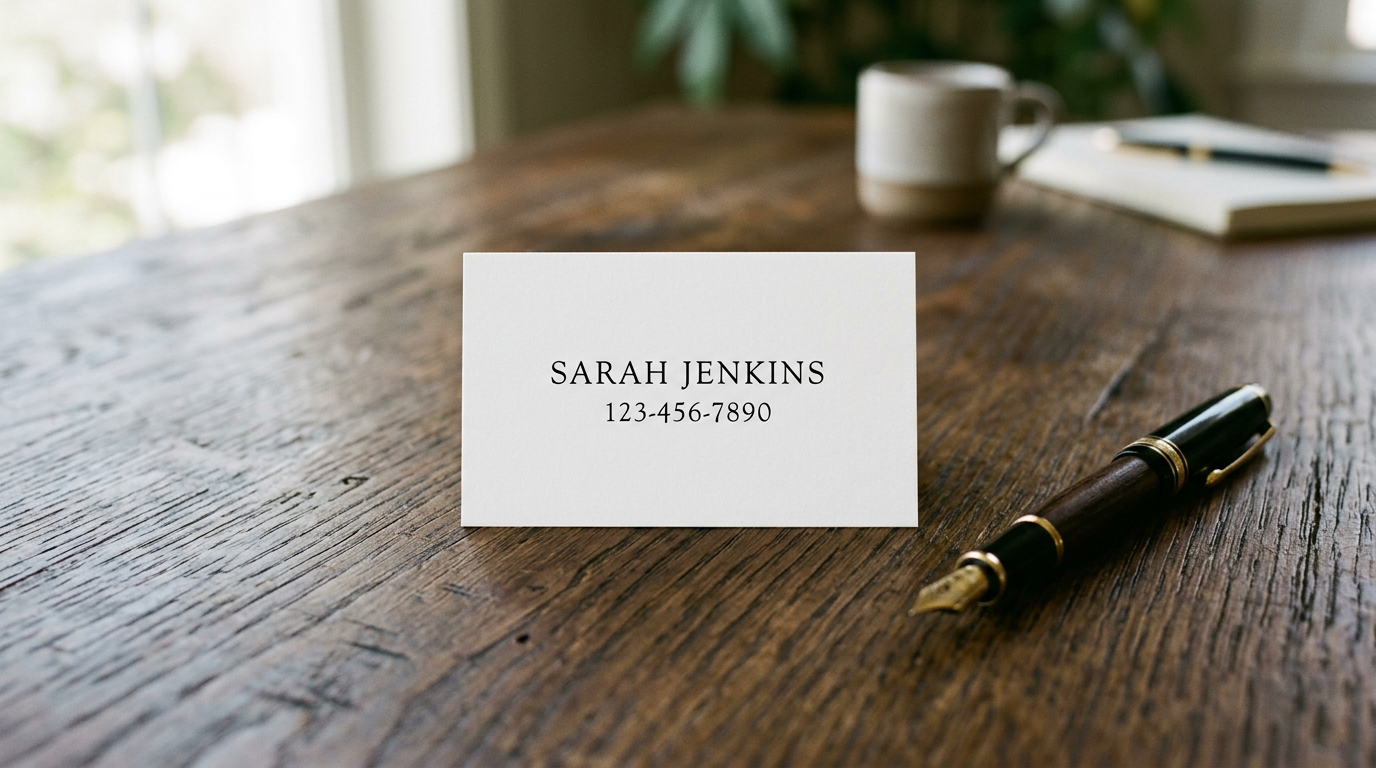
Practical rule: A functional design should contain no more than three distinct typographical hierarchies. Use your heaviest weight for your name or brand, a medium weight for your title or core value proposition, and a clear, highly legible monospaced or sans-serif font for contact details and scan instructions.
When evaluating Simple and Minimalist Business Card Designs for Professionals, look at the spacing around the action triggers. If you use a QR code, it requires a "quiet zone" - a clear margin of negative space around the matrix. Without this, the scanner software cannot isolate the alignment patterns, and the code will fail to read. A truly simple design uses this technical requirement as a structural grid, aligning the text blocks to respect the quiet zone rather than treating it as wasted space.
Why a custom business card design must route traffic dynamically
A static piece of paper is a dead end for data analytics. You cannot measure how many times a traditional card is pulled out of a drawer, nor can you track which networking event yielded the most pipeline engagement. A custom business card design bridges this gap by acting as a physical node that routes traffic into a measurable digital ecosystem.
When How to Create a Digital Business Card for Modern Professional Networking in 2026 details the architecture of a networking asset, it focuses on the destination. The card itself should point to an optimized "Link in Bio" or Smart Page. This central hub consolidates your lead capture forms, payment gateways, and social channels. By appending UTM parameters to the URL embedded in the card, you can track exactly where a connection originated in your analytics dashboard. You will know definitively whether the scans came from the Tuesday trade show or the Thursday executive dinner.
This approach also insulates your professional identity from platform risk. If you change your primary social network or migrate to a new scheduling software, you simply update the link on your Smart Page. The physical card, the wallet pass, and the QR code all continue to function perfectly, routing the prospect to your most current infrastructure.
What examples of good business cards reveal about context and environment
The most common mistake professionals make is designing a single asset for every possible environment. What works flawlessly in a quiet boardroom will fail entirely on a chaotic convention floor. Analyzing 8 Effective Personal Business Card Examples for Modern Professionals demonstrates that the best assets are highly context-dependent.
If you operate primarily in high-volume environments like trade shows, your priority is speed and visibility. A digital wallet card displayed on your phone or Apple Watch allows rapid scanning by dozens of people without carrying inventory. Conversely, in high-stakes, low-volume environments like private equity pitches or enterprise sales, the physical weight and texture of a card carry significant psychological weight. Here, a premium physical stock that serves as an anchor for an NFC chip bridges the gap between traditional authority and modern efficiency.
| Environment Type | Recommended Format | Primary Mechanism | Common Failure to Avoid |
|---|---|---|---|
| High-Volume Trade Shows | Digital Wallet Pass (Google/Apple) | High-contrast QR code displayed on a screen | Relying on physical cards that run out by day two |
| Executive Boardrooms | Heavyweight Physical + NFC | Tactile exchange with tap-to-save functionality | NFC chips that require proprietary app downloads |
| Retail / Point of Sale | Countertop Standee | High-error-correction QR code | Placing codes behind reflective glass that creates glare |
| Digital Networking | Smart Page URL | Clickable link in bio or email signature | Linking to a generic corporate homepage instead of a specific routing hub |
Reviewing Deciphering the Types of Business Cards for Modern Networking in 2026 reinforces that examples of good business cards are defined by how well they adapt to the lighting, time constraints, and social expectations of the exact room you are standing in.
When cool business card ideas distract from the professional core
There is a dangerous temptation to prioritize novelty over functionality. Many cool business card ideas fundamentally break the mechanics of professional networking. The goal is to be remembered for your competence, not for handing someone a puzzle they have to solve to find your email address.
Consider the trend of thick metal business cards equipped with NFC capabilities. Metal actively interferes with radio frequencies. A poorly engineered metal card acts as a Faraday cage, blocking its own NFC chip from transmitting unless the recipient taps their phone on a very specific, millimeter-exact plastic cutout on the back. This turns a seamless tap into an awkward, 15-second struggle where you have to teach the prospect how to use your card.
Similarly, irregular shapes - squares, circles, or die-cut silhouettes - often violate the standard dimensions of wallets, cardholders, and automated desktop scanners. If your card cannot easily fit into the recipient's organizational system, it will be left on a desk and eventually thrown away.
Practical rule: If a design choice requires you to explain how the card works to the recipient, the design has failed. The interaction must be immediately intuitive to a user who has never seen your asset before.
When exploring 6 Best Custom Business Cards for Professional Networking in 2026, you will find that the most effective options hide their complexity. The novelty should lie in how effortlessly the data transfers, not in a gimmicky physical shape that hinders practical storage.
How the best business card ideas integrate into your tech stack
Your networking asset does not exist in a vacuum; it is the front door to your Customer Relationship Management (CRM) system. The best business card ideas are built around data portability. When someone scans your code or taps your pass, the resulting VCF file must be formatted perfectly to map to the standard fields of iOS Contacts, Google Contacts, and enterprise CRM software.
This requires precise handling of the vCard payload. If your digital asset only passes a first and last name, you force the prospect to manually categorize you later. A properly structured payload passes your exact job title, company name, direct phone number, structured address, and a high-resolution profile image. When this data maps cleanly, the prospect's phone automatically categorizes you correctly, and any subsequent CRM sync captures the full breadth of your professional identity without manual data entry.
This level of integration is what separates a gimmick from a legitimate business tool. By routing traffic through a centralized Smart Page and delivering perfectly structured contact data via native operating system standards, your business card transforms from a disposable piece of paper into an active, measurable component of your sales and marketing infrastructure.
FAQ
What makes a business card design effective in 2026?
An effective design minimizes friction by ensuring contact data can be instantly transferred to a recipient's phone natively, without requiring them to type a URL or download a proprietary networking app.
Should I use a QR code or an NFC chip?
Both serve different contexts. QR codes are universally scannable from a distance and across all device types, making them ideal for high-volume environments. NFC chips offer a premium, tactile "tap" experience better suited for intimate, high-stakes meetings.
Why is my QR code failing to scan quickly?
The matrix is likely too dense because it holds a raw vCard string rather than a simple URL, or it lacks a sufficient "quiet zone" of negative space around the edges. Switching to a dynamic URL redirect will simplify the pattern and improve scan speeds.
What is the main drawback of metal business cards?
Metal interferes with radio frequencies, which can cause embedded NFC chips to fail or require highly specific, awkward tapping angles to transmit data to a smartphone.