
Most founders order their first batch of custom business cards assuming the internet is one massive, uniform print queue. They upload a file, wait a week, and open a box only to find their deep navy blue brand color rendered as a washed-out purple. The failure rarely lies in the PDF file; it lies in misunderstanding the machinery on the other side of the upload button. Industrial printing is not standardized across vendors. Choosing a provider means matching your volume, color tolerance, and turnaround needs to the specific press architecture that facility uses behind the scenes.
Quick Summary
Ordering business cards online requires matching your file scale and finish requirements to the correct industrial manufacturing process - from electrostatic toner to metal dies.
- Gang-run offset yields low per-unit costs but introduces color variance.
- Digital presses handle variable data efficiently but struggle with exact color matching.
- Letterpress and foil require vector artwork and expensive dedicated die setups.
- Smart card printers embed structural NFC chips that lock you to a vendor's URL ecosystem.
Table of Contents
- The Lens: Isolating the Manufacturing Constraint
- 1. Gang-Run Offset Providers
- 2. Digital Short-Run Specialists
- 3. Premium Letterpress and Foil Studios
- 4. Print-on-Demand Fulfillment Platforms
- 5. Template-Driven Web-to-Print Services
- 6. Eco-Friendly and Recycled Substrate Printers
- 7. Hybrid NFC and Smart Card Printers
- Mapping Your Manufacturing Bottleneck
- FAQ
- Recommended Reads
The Lens: Isolating the Manufacturing Constraint
Before evaluating providers offering custom business cards online, you must isolate your primary constraint. Are you printing 50,000 units to distribute across twenty retail franchises, or 250 thick, gilded units for a high-stakes real estate pitch? Offset lithography scales cheaply but punishes prepress mistakes; digital presses forgive variable data errors but cost significantly more at scale. Every service category reviewed below is judged strictly on its press architecture and what physically happens to your artwork when it leaves the browser.
1. Gang-Run Offset Providers
These are the massive industrial printers behind the most aggressively priced bulk cards available, built for operations that need thousands of units without breaking the budget.
Your design is never printed alone. The facility's prepress software aggregates dozens of different customer files onto a single massive parent sheet. An offset press uses wet ink and aluminum plates, applying cyan, magenta, yellow, and black in four separate, rapid passes. Because the ink keys on the press must be balanced for the entire parent sheet simultaneously, the press operator averages out the color mix. If your dark slate logo sits right next to another customer's bright yellow design on the sheet, the ink distribution mechanically shifts to accommodate both.
Unbeatable scale with built-in color instability
You will never achieve exact Pantone matching on a gang run. Expect a visible shift in tone between what your monitor displays and what arrives on the delivery truck. If your corporate identity relies on an unvarying, specific shade of green, you must skip gang-run providers and pay the heavy setup fee for dedicated offset runs instead. As a guide to the best professional printing services in 2026 will point out, prioritizing scale always comes with a compromise in precision.
Practical rule: Never use a thin, symmetrical outer border on a gang-run print order. The massive guillotine blade draw pulls the paper slightly during bulk cutting, shifting the margin up to 1/16th of an inch and making your border look noticeably lopsided.
2. Digital Short-Run Specialists
Digital print providers cater directly to freelancers, consultants, and independent agents who need 100 to 500 units quickly, often requiring multiple employee names or title variations within the exact same batch.
Unlike offset operations, digital presses completely eliminate metal plates. They utilize electrostatic rollers to fuse dry toner directly onto the paper stock, or they run specialized liquid electrophotography. Because there is absolutely no plate-making setup time, the first print costs the same to run as the thousandth. This specific architecture enables variable data printing - you can swap out employee headshots, phone numbers, or QR codes on every single card in a 500-card run without incurring a single setup fee.
Immediate execution at a high per-unit penalty
The unit economics collapse rapidly at commercial volumes. Evaluating custom card printing at this scale means accepting that once an order crosses 1,000 units, the lack of setup fees is entirely swallowed by the higher ongoing cost of digital toner consumables. Furthermore, standard digital toner sits on top of the paper fibers rather than absorbing deeply into them. This causes visible cracking on the ink along fold lines. To prevent this cracking on solid background colors, many digital facilities force you to add a soft-touch plastic laminate, which ruins your ability to write on the card with a standard ballpoint pen.
3. Premium Letterpress and Foil Studios
Boutique print shops specializing in letterpress and hot foil stamping target luxury brands, architects, and high-end hospitality venues where the physical, tactile weight of custom made business cards matters far more than the contact information printed on them.
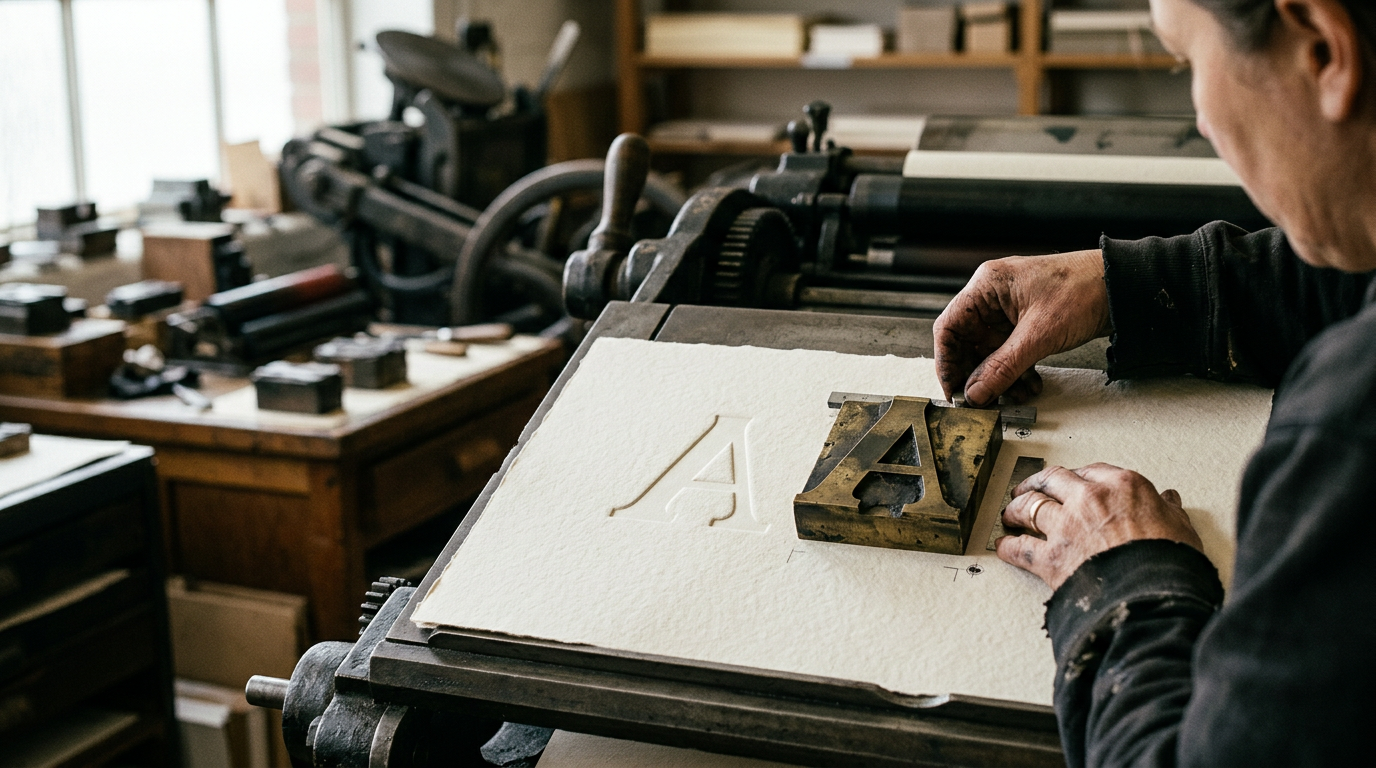
Letterpress operates as an analog relief process. The prepress department mills a physical magnesium or copper die based strictly on your vector artwork. This heavy metal die is locked into a vintage mechanical press, manually inked, and physically smashed into uncalendered, thick cotton paper stock. The extreme pressure leaves a deep, tactile deboss in the paper. Hot foil stamping uses an identical metal die, but instead of using wet ink, a heated element melts a thin metallic film directly onto the substrate.
Maximum tactile impact with severe design restrictions
You cannot print raster photographs, gradients, or delicate typography using this method. Letterpress demands high-contrast vector art; lines thinner than 0.25 points will quite literally snap off the metal die during the stamping process. When selecting materials and finishing options, remember that a deep impression on the front physically pushes the paper out on the back. To hide this bulge, premium studios print two thinner sheets separately and glue them together under high pressure - a process called duplexing that doubles your material costs and adds days to the drying time.
4. Print-on-Demand Fulfillment Platforms
API-driven fulfillment platforms are engineered for distributed enterprises, franchises, and large marketing agencies that need to produce and ship materials to hundreds of remote employees without constant manual oversight.
These printing firms operate entirely headless manufacturing facilities. You connect your corporate HR software or intranet portal directly to their print API using webhooks. When a new regional manager is onboarded, the system pipes their credentials directly into a locked brand template. The server automatically generates a flattened, print-ready PDF, routes it to the digital press queue physically located nearest to that employee, and ships it. The entire pipeline from HR data entry to the staff member deciding to get business cards delivered to their home office happens instantly.
Frictionless distribution that removes quality control
By fully automating the prepress stage, you forfeit the vital safety net of a human graphic designer visually checking the proof. Setting up this infrastructure is arguably the most efficient way to order bulk business cards for small business teams, provided the bounding templates are bulletproof. If a new hire has an exceptionally long surname that overflows the strict template parameters, the API will happily execute the print with the text running completely off the trimmed edge of the paper. You must rigorously stress-test your dynamic templates for extreme data edge cases before putting these APIs into production.
5. Template-Driven Web-to-Print Services
Retail online business cards platforms cater exclusively to independent contractors, gig workers, and sole proprietors who lack access to professional layout software like Adobe Illustrator and need to design and order entirely within the same browser tab.
The core technology driving this category is the server-side browser canvas. The platform hosts thousands of pre-configured, modular vector templates. While you design, the browser editor locks your color workspace to CMYK and mathematically restricts you from placing critical text outside the safety margin. Once you click authorize, the server generates a technically flawless PDF guaranteed to pass the plant's automated pre-flight checks, routing it straight to the digital press.
Foolproof file setup paired with generic aesthetics
You are designing using the exact same foundational templates as thousands of your direct competitors. Because the system is engineered to prevent user errors, it aggressively limits your ability to utilize custom spot colors, complex overlapping vectors, or proprietary typography. Browser-based typography relies on web fonts licensed specifically for server-side generation; if your brand guidelines mandate a specific foundry typeface, the engine will force a substitution. If you already possess a finished file from a professional designer, running it through a template-driven builder is a redundant step that usually compresses and degrades your raster assets.
6. Eco-Friendly and Recycled Substrate Printers
Environmentally conscious print facilities cater to sustainable brands, non-profits, and organic product manufacturers who cannot justify handing out virgin-fiber, plastic-coated paper to their clients.
True eco-friendly printing alters both the physical substrate and the press chemistry. Instead of standard petroleum-based inks, these facilities run vegetable or soy-based inks that release significantly fewer volatile organic compounds (VOCs) during the drying phase. The paper stocks are composed entirely of post-consumer waste (PCW) recycled fibers. Because recycled paper consists of shorter, more broken fibers than virgin paper, the presses must be carefully calibrated to handle much higher ink absorption rates to prevent the designs from bleeding.
Ethical alignment at the cost of durability
Uncoated recycled paper acts exactly like a sponge. It absorbs wet ink rapidly, meaning photographs will look significantly darker, flatter, and less sharp than they do on a backlit monitor. While not always the top choice among options for fast business cards due to specialized sourcing constraints, the real limit is durability. These cards cannot be finished with standard plastic laminate coatings because that renders them unrecyclable. Consequently, the edges of dark-colored cards will scuff and expose white paper fibers after just a few days of friction inside a wallet.
7. Hybrid NFC and Smart Card Printers
Hardware-focused print vendors serve tech-forward sales teams, SaaS executives, and networking professionals who want to carry exactly one physical card that transmits their digital profile via a smartphone tap.
The provider manufactures a thick, durable card - often from PVC, metal, or dense composite wood. During fabrication, they embed a Near Field Communication (NFC) inlay consisting of a microchip and a copper antenna loop. This chip is encoded using the NDEF (NFC Data Exchange Format) protocol with a small string of data, typically a URL pointing to a hosted link-in-bio page. When a smartphone is brought within an inch of the card, the phone's electromagnetic field powers the antenna, reading the URL instantly.
Infinite updatability hindered by recipient hardware
The physical card is entirely useless if the URL it points to breaks, meaning you are tethering your physical networking tool to an ongoing software subscription. High-end providers permanently lock the chip's destination URL at the factory to route the tap through their own secure redirection servers. If that vendor goes bankrupt and their redirection server drops, your physical cards instantly become dead plastic rectangles.
Practical rule: Never deploy an NFC card without also printing a QR code on the back. It ensures continuity when the tap fails, serving as a reliable backup when you create a digital business card with QR codes.
Mapping Your Manufacturing Bottleneck
Finding the best business cards online is a matter of knowing exactly what your networking environment demands before you look at a pricing page.
- If your bottleneck is budget and you need to blanket a massive trade show, take the gang-run offset route.
- If your bottleneck is variable employee data across multiple regions, take the API fulfillment platform.
- If your bottleneck is conveying absolute luxury and budget is irrelevant, take the letterpress studio.
- If your bottleneck is carrying less physical inventory while tracking networking analytics, take the hybrid NFC route.
FAQ
Why do my printed colors look darker than my screen?
Your monitor displays colors using RGB (Red, Green, Blue) light, which is additive and inherently bright. Printing uses CMYK (Cyan, Magenta, Yellow, Black) ink, which is subtractive and absorbs light. CMYK simply cannot reproduce the bright, neon spectrum of RGB, resulting in darker, flatter prints.
What is the difference between uncoated and coated cardstock?
Coated cardstock has a thin clay layer applied at the paper mill, which stops ink from absorbing into the fibers, keeping images sharp and colors vibrant. Uncoated cardstock lacks this layer, allowing ink to sink in, which creates a softer, more textured look but reduces image sharpness.
Can I print a photograph using letterpress?
No. Letterpress requires solid vector shapes to mill the physical metal die. Photographs are made of thousands of tiny raster pixels and gradients, which cannot be translated into a solid metal stamp.